Songwriting Secrets: Harness the Circle of Fifths for Chord Progressions
Tired of staring at blank pages, wondering how to transform a simple melody into a complete song? The Circle of Fifths isn't just a confusing chart found in old textbooks—it's your secret weapon for crafting professional-grade compositions from scratch. Many songwriters feel stuck because they don't know which chords sound good together or how to move from a verse to a chorus without it sounding "wrong."
Let’s break down how the Circle of Fifths turns chord puzzles into chart-topping songs. We make music theory accessible and your songwriting process effortless. By using an interactive music tool, you can visualize these relationships in real-time, helping you hear the music before you even play a note. Let’s turn that "blank page anxiety" into a finished track.

Understanding Basic Song Structure with Circle of Fifths
Before we jump into specific chords, we need to understand the "skeleton" of a song. A song is more than just a repeating loop; it is a journey with different rooms. The Circle of Fifths helps you organize these rooms so the listener doesn't get lost or bored.
The Three Pillars: Verse, Chorus, and Bridge
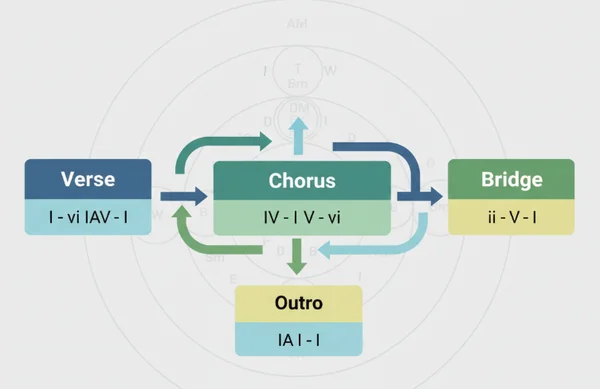
Most popular songs rely on three main sections: the Verse, the Chorus, and the Bridge. Each serves a specific purpose in your story. The Verse is where you give the details and build the narrative. Musically, it often stays close to the "home" chord to keep things grounded.
The Chorus is the emotional peak. It’s the part everyone sings along to. This is where you want your most powerful chord movements. Finally, the Bridge provides a "twist." It usually happens about two-thirds of the way through the song. On the Circle of Fifths, you might look for chords a bit further away from your starting point to create this needed contrast.
Mapping Emotional Arcs to Musical Sections
Music is about emotion. If your song stays on the same three chords for five minutes, the emotional arc is a flat line. To create a "roller coaster" for your listener, you can use the Circle of Fifths to find "neighboring" chords. Chords that are right next to each other on the circle sound very stable and safe.
If you want to create a sense of longing or surprise, you might jump to the relative minor or a chord that is two steps away on the circle. Understanding these distances allows you to map out the feelings of your song sections. A verse might feel "searching" by using minor chords, while the chorus feels "resolved" by landing heavily on the major home chord.
Choosing Your Foundation: Key Selection and Chord Progressions
Every great song starts with a "Key." Think of a key as a color palette. If you choose the key of G Major, you are choosing a specific set of notes and chords that naturally live together. Choosing the right key is the first step in using the circle of fifths chart effectively.
Finding the Perfect Key for Your Song's Mood
Different keys can suggest different moods. While this is subjective, many songwriters find that keys with many sharps (like E Major) sound bright and energetic, while keys with flats (like Ab Major) sound warm or deep.
When you use an online tool, you can quickly click through different keys to see which one resonates with your lyrics. If you are writing a sad song about a rainy day, you might explore chord relationships in a minor key like D Minor or A Minor. The Circle of Fifths makes it easy to see which major and minor keys are related, so you can switch between them to find the perfect "vibe."
Building Your Chord Palette: From I to vi
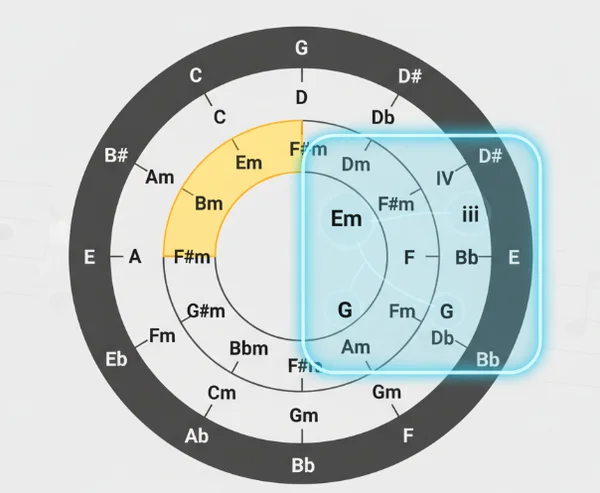
Once you pick a key, the Circle of Fifths shows you the "Diatonic Chords." These are the six or seven chords that naturally fit in that key. In music theory, we often label these with Roman numerals like I, ii, iii, IV, V, and vi.
The beauty of the Circle of Fifths is that these chords are always grouped together. If you look at C Major on the circle, the chords F (IV) and G (V) are right next to it. Just below them, you will find their relative minors: D minor (ii), A minor (vi), and E minor (iii). These six chords are your "palette." You can mix and match these six chords, and they will almost always sound harmonious because they share similar notes.
Creating Tension and Release: The Magic of V7 to I
The most important relationship in songwriting is the move from the "V" (five) chord back to the "I" (one) chord. This is called a cadence. It creates a sense of "coming home." On the Circle of Fifths, the V chord is always one step clockwise from your home key.
For example, if you are in the key of G, the V chord is D. If you play a D7 chord and then move to a G chord, your listener feels a sense of relief and completion. This "Tension and Release" is the engine that drives a song forward. You can use this trick at the end of a chorus to make the start of the next verse feel like a fresh beginning.
Crafting Your First Song: A Step-by-Step Walkthrough
Now that we have the theory, let’s build a song. For this example, let’s pick the Key of G Major. It is a favorite for guitarists and piano players alike.
Step 1: Establishing the Verse Progression
For the verse, we want something stable but moving. Let's pick three chords from our palette. A classic choice is G - C - D (the I, IV, and V). However, to make it more interesting, let's start with the home chord and move to a minor chord for a bit of "storytelling" flavor.
Try this: G Major — Em (vi) — C Major — G Major. The move from G to E minor is very smooth because they share two notes. This creates a gentle, reflective mood for your verse lyrics. You can use an interactive tool to hear how these chords sound together before you pick up your instrument.
Step 2: Building the Chorus with Power Chords
The chorus needs to pop. We want the listener to feel a lift in energy. A great way to do this is to focus on the "Primary Chords" (I, IV, and V). These are the strongest relationships on the Circle of Fifths.
Try this for your chorus: C Major (IV) — D Major (V) — G Major (I) — G Major (I). Starting on the C Major (the "subdominant") gives the chorus a feeling of "opening up." Ending on the G Major (the "tonic") makes the chorus feel catchy and resolved. This is the foundation of thousands of hit songs because the Circle of Fifths proves these chords are naturally attracted to each other.
Step 3: Adding Depth with the Bridge
After two verses and two choruses, your song might start to feel repetitive. This is where the Bridge comes in. We want to go somewhere different. Look at the Circle of Fifths and find a chord we haven't used much.
In G Major, we have the A Minor (ii) and B Minor (iii). Let’s use those to create a "searching" feeling. Try: Am — Bm — C — D7. This progression climbs upward, building tension. The D7 at the end is the "V" chord, which perfectly sets up the final, explosive chorus in G Major. Discover ‘outside’ chords on the Circle to elevate your songs. This pro trick adds depth without complexity.
Step 4: Creating a Cohesive Song with the Interactive Tool
Songwriting is trial and error. If the key of G strains your voice or the bridge feels moody, switch keys instantly with our tool—no theory headaches! This is where using the online songwriting tool becomes essential.
Instead of re-calculating all your chords by hand, you can simply click a new key on the circle. The tool will instantly show you the new I, IV, V, and minor chords. This allows you to stay in the "creative zone" rather than the "math zone." You can visualize the whole song structure at once, ensuring that your verse, chorus, and bridge all belong to the same musical family.

Your Journey from Beginner to Confident Songwriter
Songwriting doesn't have to be a mystery. By following these four essential steps—establishing a verse, building a chorus, adding a bridge, and using visual tools—you can create music that sounds professional and emotionally resonant. The Circle of Fifths is your creativity compass. It guides your chord choices so you stay focused but never boxed in.
Hands-on experimentation beats passive learning—try tweaking chords in our tool right now! Focus on the relationships between the chords. See how the "neighbors" on the circle create harmony, and how jumping across the circle creates drama. If you are ready to start creating, head over to our interactive tool and start clicking. Your next great song is just a few clicks away!
The Takeaway
How do I use the Circle of Fifths to write a song?
The easiest way is to pick a "home" key on the circle. The chords immediately to the left and right, along with the three chords directly below them, are your "safe" chords. Use these to build your verse and chorus. If you want to see this in action, you can use a circle of fifths tool to highlight these groups automatically.
What are the essential parts of a complete song?
Most complete songs include a Verse (the story), a Chorus (the main theme/hook), and a Bridge (a change in direction). Some songs also include an intro, an outro, and a pre-chorus, but the first three are the most critical for structure.
How can I find the right chords for my melody using the Circle of Fifths?
If you have a melody, identify the notes you are singing most often. Look at the Circle of Fifths to find a key that contains those notes. Once you find the key, try playing the "I, IV, and V" chords from that key under your melody. Usually, one of those three will fit perfectly. You can try our free tool to click and listen to different chords while you sing your melody.
What's the easiest way to transition between different sections of a song?
The "V to I" transition (the Dominant to Tonic) is the most effective way to move between sections. If your song is in G, ending a section on a D or D7 chord will make the listener crave the return to G, making the transition feel natural and satisfying.