"Why Does This Sound Wrong?" – Circle of Fifths Fixes for Common Mistakes
Have you ever written a chord progression that just feels "off"? Or composed a beautiful melody that somehow clashes with your harmony? Maybe you've struggled to create that perfect emotional impact, but your music ends up sounding flat. Countless songwriters, producers, and musicians at every level face these exact same frustrations.
Many of these problems stem from a misunderstanding of how notes and chords relate to each other within a key. The good news is that there's a powerful map to guide you through this harmonic landscape: the Circle of Fifths.
In this article, we'll diagnose common musical mistakes and show you exactly how to fix them. By the end, you'll understand why your music sometimes sounds wrong and, more importantly, how to make it sound right. Let's dive in and transform your compositions with our interactive tool.
Diagnosing Dissonance: When Chords Don't Work Together
One of the most common issues in songwriting is a chord progression that doesn't flow. It might sound weak, disjointed, or simply incorrect. This often happens when chords are chosen randomly or without understanding their function within a key. The Circle of Fifths acts as a "harmony checker," instantly showing you which chords belong together.
The 5 Most Common Chord Progression Mistakes
Many songwriters, especially those just starting, fall into a few common traps. Recognizing them is the first step to writing stronger, more cohesive music.
- Using Out-of-Key Chords Randomly: Throwing in a chord that doesn't belong to the key can create harsh, unintended dissonance. For example, playing an A major chord in the key of C major will often sound jarring because it contains a C# note, which clashes with the C major scale.
- Weak Resolutions: Music is about tension and release. A progression that never resolves to the "home" chord (the tonic) can leave the listener feeling unsatisfied.
- Overusing Primary Chords: Relying only on the I, IV, and V chords (like C, F, and G in C major) can make your song sound predictable and a bit childish.
- Ignoring Minor Chords: The diatonic minor chords (ii, iii, and vi) add emotional depth and color. A progression with only major chords often lacks nuance.
- Awkward Jumps: Moving between chords that are harmonically distant can break the flow. For instance, jumping from C major directly to F# major can feel abrupt without proper setup.
How the Circle of Fifths Reveals Hidden Harmonic Clashes
The Circle of Fifths is more than just a diagram; it's a visual representation of harmonic relationships. When you select a key on an interactive circle, it instantly shows you the family of chords that naturally sound good together.
Think of a key as a home. The chords closest to your home key on the circle are its closest relatives—they share the most common notes and create the smoothest transitions. For example, in the key of C major, its neighbors G major and F major are the most natural-sounding chords to move to. Our free tool highlights these relationships, making it easy to see which chords are "safe" and which ones are more adventurous. By visualizing these connections, you can immediately spot a chord that doesn't belong and find a better replacement.

Melody-Harmony Mismatches: Fixing Vocal Lines and Instrumentation
A great song is a perfect marriage of melody and harmony. But sometimes, they don't get along. You might write a powerful vocal line, but when you put chords under it, something sounds wrong. This clash happens when the notes in your melody fight with the notes in your chords.
Identifying Melodic Notes That Clash With Your Chord Progression
The most common reason for a melody-harmony clash is when a prominent melodic note is not part of the underlying chord or the song's key. For example, if your melody holds a long F# note while the band is playing a C major chord (C-E-G), the clash will be obvious and unpleasant.
The Circle of Fifths helps you prevent this. Select your key on our interactive circle to see the complete scale. This gives you a "palette" of safe notes for your melody. If your chord progression stays within the key, any melody you write using notes from that key's scale will fundamentally sound compatible.
Using Relative Minor to Find Complementary Melodic Ideas
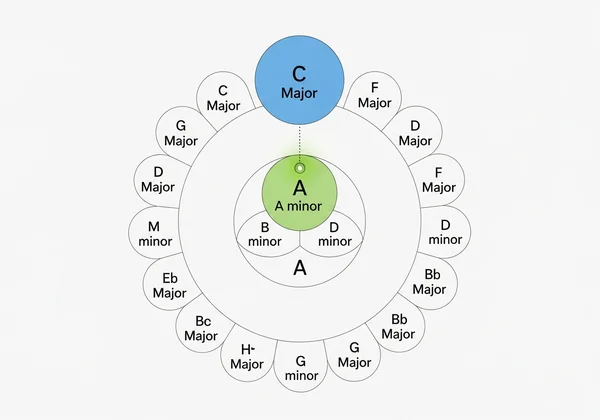
Feeling stuck writing melodies in a major key? The Circle of Fifths offers a brilliant shortcut to new emotional territory: the relative minor. Every major key has a relative minor key that shares the exact same key signature (the same sharps or flats). On the circle, it's located right inside the major key. For C major, it's A minor.
This relationship is a goldmine for songwriters. You can use the A minor scale to write a darker, more melancholic melody over your C major chord progression. This creates a sophisticated, emotionally rich sound without introducing any clashing notes. It’s a simple trick used in countless hit songs to add depth and variety.
Creating Emotional Impact: Tension and Release Techniques
Music is storytelling, and every good story needs tension and release. In music, this is created by moving away from the "home" chord (creating tension) and then returning to it (providing a satisfying release). The Circle of Fifths is your master guide for controlling this emotional journey.
The Circle of Fifths Formula for Building Tension
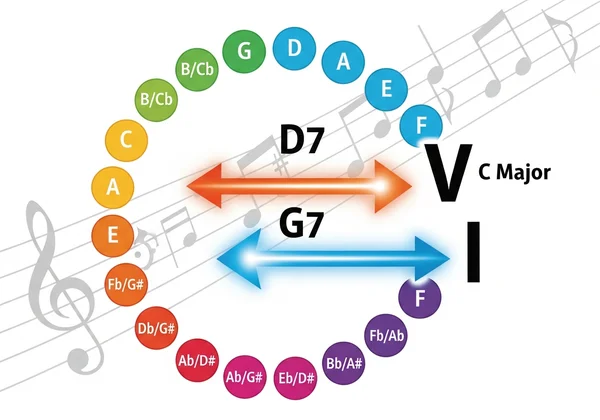
The most powerful way to build harmonic tension is by using the dominant chord (the V chord). On the Circle of Fifths, the dominant chord is always located one step clockwise from your home key. For example, the dominant of C is G. The G7 chord, in particular, contains a tritone interval that desperately wants to resolve back to C.
To create even more tension, try using a chain of dominant chords by moving counter-clockwise around the circle. This creates a progression like E7 -> A7 -> D7 -> G7 -> C. The result is a powerful, cascading sense of momentum that pulls the listener toward the final resolution. Explore this on our Circle of Fifths tool to see and hear this effect in action.
Resolving Dissonance Effectively: The Cadence Solution
A cadence is a two-chord sequence that concludes a musical phrase, like punctuation at the end of a sentence. The strongest and most common cadence is the "authentic cadence," which moves from the dominant (V) to the tonic (I), such as G to C. This provides a strong sense of finality and closure.
Another popular option is the "plagal cadence" (IV to I), like F to C. This is often called the "Amen" cadence and feels softer and less final. By understanding these simple V-I and IV-I relationships, which are clearly visible on the Circle of Fifths, you can end your musical phrases with confidence and emotional clarity.
The Outro
The mystery of why your music sometimes "sounds wrong" is finally solved. By using the Circle of Fifths, you can diagnose clashing chords, fix mismatched melodies, and master the art of tension and release. It transforms music theory from an abstract concept into a practical, problem-solving toolkit.
Actionable Takeaways:
- To fix a clashing progression, stick to the six diatonic chords shown for your key on the Circle of Fifths.
- To create a new melodic mood, try using notes from the relative minor key.
- For powerful tension and release, use the V-I relationship, easily found by looking one step clockwise on the circle.
Harmonic challenges shouldn't stand in your way as a creator. The answers are right at your fingertips.
Ready to fix your music and write with confidence? Try these fixes yourself with our interactive Circle of Fifths tool and transform your compositions today.
Wrapping Up
How can I tell if my chord progression is weak?
A weak chord progression often lacks a clear sense of direction or resolution. If your song feels like it's wandering aimlessly, try building your progression around the I, IV, and V chords of your key. You can instantly find these core chords for any key using our interactive chart to build a stronger harmonic foundation.
Why do my melodies sound out of place with my chords?
This usually happens when a key note in your melody is not part of the underlying chord or the song's overall key. Use the Circle of Fifths to identify the correct scale for your key. Sticking to these notes for your melody will ensure it harmonizes beautifully with your chords.
What's the fastest way to learn how to fix harmony mistakes?
The fastest way to learn how to fix harmony mistakes is by visualizing and hearing the relationships rather than just reading about theory. Our interactive tool lets you click on keys, see related chords instantly, and even hear them. This hands-on experience connects theory to sound, accelerating your learning.
Can the Circle of Fifths help me write more emotional music?
Absolutely. Emotion in music often comes from the interplay between major (happy, bright) and minor (sad, reflective) chords. The Circle of Fifths clearly shows you the relative minor for any major key, giving you an instant palette of chords to add emotional depth and sophistication to your songwriting.
How do I transition smoothly between different keys in a song?
The Circle of Fifths makes modulation (changing keys) simple. The smoothest key changes are usually to adjacent keys on the circle (e.g., from C major to G major or F major). A common technique is to use the dominant (V) chord of the new key to lead into it. For example, to move from C to G, you would use D7 (the V of G) right before landing on G.