Sharp or Flat Keys on the Circle of Fifths
Most learners can point to G or B-flat on the wheel, but the real hesitation starts one step later: should this idea be read as a sharp key or a flat key? That is where the circle stops being a poster and starts becoming a reading tool. A good choice is not about sounding smarter. It is about choosing the spelling that keeps the notation easy to scan, teach, and remember.
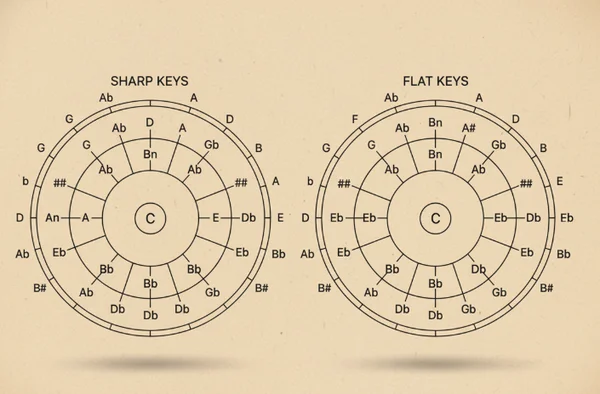
The helpful part is that you do not need to guess blindly. The site’s interactive circle chart lets you compare both accidental families, and its settings make the decision visible instead of abstract. Once you know what the clockwise and counterclockwise pattern means, the sharp-flat choice gets much faster.
Why the choice feels harder than it should
A lot of beginners memorize the circle as a list of letters and stop there. They know C sits at the top, G is one step to the right, and F is one step to the left. Then a score appears with several accidentals, and the stored memory is not enough to answer the practical question: which spelling will be easier to read right now?
Part of the confusion comes from mixing 2 jobs together. The circle explains relationships between keys, but notation asks you to recognize patterns quickly on the page. Those are connected, not identical. If you only memorize the layout without connecting it to key signatures, you may know the map but still hesitate at the doorway.
A [Utah State piano handout] notes that common notation uses 15 major key spellings: 7 sharp keys, 7 flat keys, and 1 key with no accidentals. That fixed range matters because it turns a messy-looking page into a predictable system. When you also remember the order F-C-G-D-A-E-B for sharps and B-E-A-D-G-C-F for flats, the circle becomes a shortcut instead of extra homework.
What the circle is showing when you move right or left
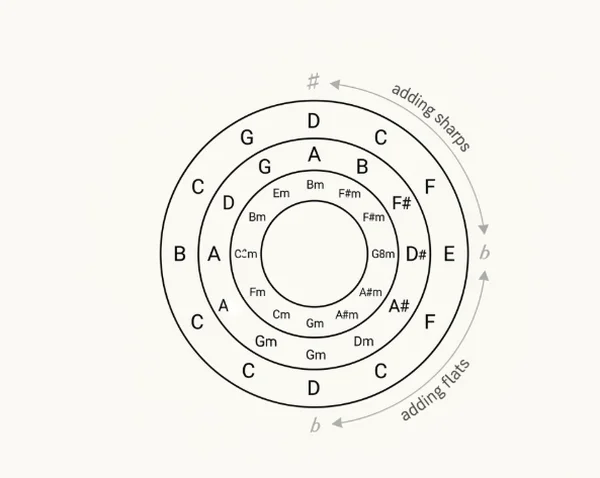
The circle becomes much clearer when you treat each step as an accidental change, not just a new letter name. A [UW Oshkosh circle overview]explains the core rule plainly: every 1 clockwise move adds 1 sharp. Moving in the other direction adds 1 flat. That is the simplest memory rule in the whole system.
So if you move from C to G, you expect one sharp. Move again to D, and you expect two sharps. Go left from C to F, and you expect one flat. Go left again to B-flat, and you expect two flats. The labels are changing, but the reading habit stays the same: one step, one new accidental.
This is where the sharp-and-flat toggle earns its place. Instead of forcing yourself to imagine both spellings, you can compare them in the same browser session. That makes it much easier to see whether a musical idea naturally belongs to the sharp side or the flat side before you practice it.
When a sharp key is usually the cleaner choice
A sharp spelling is often easier when your material already points toward the clockwise half of the circle. Keys like G, D, A, and E build in a way that feels visually consistent because each new step adds only one new sharp to the previous signature. If your notes, scale drills, or chord work already lean that direction, staying with the sharp family usually keeps the page cleaner.
Sharp keys also feel natural when you are comparing nearby clockwise neighbors. G to D, or D to A, is easy to follow because the extra accidental arrives in a predictable order. That matters in lessons and practice routines where you want the student to notice one change at a time, not decode an entirely new notation system.
Relative minors strengthen this logic. The [Colorado College key-signature guide]points out that a signature indicates either a major key or its relative minor key. That is why G major and E minor or D major and B minor travel as paired reading options. On the site, the relative minor view helps you confirm that pairing without leaving the main chart.
When a flat key is easier to read and teach
Flat keys usually make more sense when the music already lives on the counterclockwise side. F, B-flat, E-flat, and A-flat are common classroom and ensemble landmarks because the notation often looks more stable than a sharp-heavy enharmonic alternative. The goal is not to prove that flat keys are always better. It is to notice when they reduce clutter.
This matters most in shared reading situations. If you are preparing a handout, explaining a progression, or walking a beginner through key signatures, flat spellings often make the pattern easier to discuss in plain language. Many students recognize B-flat and E-flat sooner than they recognize awkward spellings that technically point to the same pitch area.
The circle helps here because it does not force a single answer. It shows families. If you land on the left side and the notation looks simpler with flats, that is usually the better teaching choice. If you jump to a sharp-heavy spelling just because the wheel can support it, you may make the reading task harder than the musical task.
A 1-minute check inside the site
Here is a practical way to decide between the two spellings before you start drilling scales or building progressions.
1. Find the key area first
Open the interactive chart and locate the musical center you are working with. Do not worry about the perfect label yet. Just identify whether the sound and note set seem closer to the clockwise or counterclockwise side.
2. Compare accidental load
Now look at how many accidentals each likely spelling would bring. If one option clearly keeps the signature simpler, keep that one. The seven-sharp and seven-flat system gives you a fixed ceiling, but most reading decisions happen much earlier, where clarity matters more than theoretical completeness.
3. Toggle relative minor labels
If the major label feels uncertain, switch on the minor pairing and check whether the related minor makes the notation logic easier to understand. Because relative pairs share a signature, this is often the fastest way to confirm that you are still inside the right accidental family.
4. Hide and reveal the signatures
Use the hidden-signature setting as a quick self-test. Predict the accidentals first, then reveal them. That turns the circle into a reading exercise instead of a passive diagram.
5. Keep the cleaner view for practice
If you want to stay with one spelling for a lesson, worksheet, or personal review session, the site’s PDF export can preserve the version that was easiest to read. That is especially useful when you want consistency across a few neighboring keys instead of restarting the decision every time.
Key takeaways and next steps
The sharp-flat question is really a readability question. The circle gives you a visual reason for the choice: clockwise adds sharps, counterclockwise adds flats, and relative minors keep the same key signature as their major partners. Once you connect those three ideas, the decision becomes much less dramatic.
Use the chart to compare families, not to hunt for a single magical label. If one spelling keeps the key signature cleaner, easier to teach, and easier to remember, that is usually the right one for the moment. The site works best when you treat it as a fast visual check before practice, not as a wall chart you only glance at once.
The Takeaway
Do sharp and flat keys follow the same pattern on the circle?
Yes. The pattern is symmetrical in function even though the accidentals are different. Moving right adds sharps one at a time, and moving left adds flats one at a time.
How do relative minors help with the choice?
They show whether you are still working inside the same key-signature family. If the major and minor pairing makes sense, your sharp or flat decision is probably consistent too.
What should I do when two spellings seem possible?
Choose the one that makes the notation easier to read for the player in front of you. In most practice and teaching situations, the cleaner spelling is more useful than the more theoretical one.