Master Smooth Key Changes: Circle of Fifths Modulation
The frustration of awkward key changes in your compositions plagues even experienced musicians. You might be writing a beautiful melody in C Major, but when you try to move to a new section, the transition feels jarring. How do you transition between keys seamlessly while maintaining musical cohesion?
How can you make your music flow naturally from one key to the next? The answer lies in a tool you likely already know but may not fully utilize: the Circle of Fifths. This powerful concept is far more than a static chart of key signatures—it's your ultimate roadmap for elegant modulations. These transitions transform simple songs into sophisticated musical journeys that keep your listeners engaged.
In this guide, we will unlock advanced modulation techniques that professional composers use to create smooth, convincing key changes. Whether you are writing a pop ballad or a complex film score, you can use our interactive tool to visualize these relationships in real-time. Let's explore how to master the art of moving between keys with grace and precision.
Understanding the Foundation of Modulation
Before we dive into specific techniques, we must understand what modulation actually is and why some keys "get along" better than others. Modulation is the process of changing from one tonic (the home key) to another. It adds variety, emotional depth, and structural clarity to your music.
What is Modulation and Why the Circle of Fifths Matters
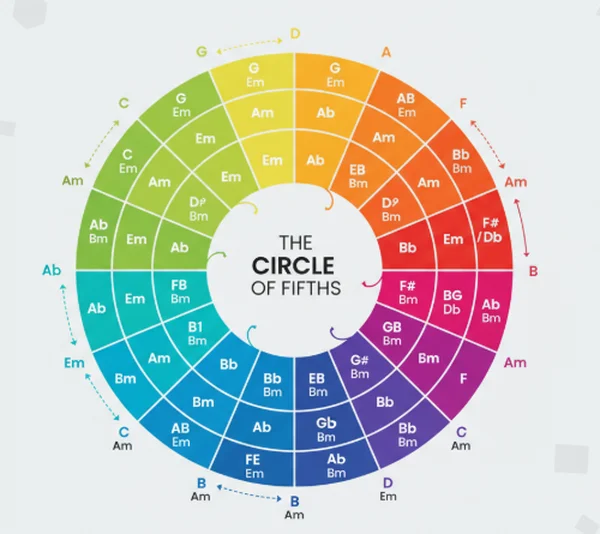
At its heart, modulation is about moving through musical space. The Circle of Fifths is the most effective way to visualize this space. Keys that are next to each other on the circle share six out of seven notes. For example, C Major and G Major are neighbors. They're "closely related" because they share so many notes, which makes moving between them feel natural to the human ear.
The more steps you move around the circle, the more "distant" the keys become, and the more "surprising" the modulation feels. By using an online music theory tool, you can quickly see which keys are neighbors and which require more effort to reach.
Types of Modulation: Diatonic, Chromatic, and Enharmonic
Not all key changes are created equal. Composers generally categorize them into three main types:
- Diatonic Modulation: This is the smoothest type. It uses chords that exist naturally in both the old and new keys. It feels very stable and "safe."
- Chromatic Modulation: This involves changing a note by a half-step, such as turning a C natural into a C#. It creates a more dramatic, colorful shift that signals a big emotional change.
- Enharmonic Modulation: This is a "trick" of music notation. You treat a chord as if it belongs to a completely different key by renaming the notes. This allows you to jump to very distant keys instantly.
Common-Tone Modulation: The Seamless Bridge Between Keys
One of the most elegant ways to move between keys is to focus on a single note that both keys share. This is known as common-tone modulation. Instead of using a whole chord as a bridge, you use a single, sustained note to lead the listener's ear into the new harmonic territory.
Identifying Common Tones Between Related Keys
To use this technique, find a note that exists in both your current key and your target key. If you are moving from C Major to E Major, the note "E" is a perfect candidate. It is the 3rd of C Major and the tonic (1st) of E Major.
Using a visual circle of fifths helps you identify these shared tones without the mental math. You can simply look at the scale degrees of your current key and compare them to the notes in your destination.
Step-by-Step Common-Tone Modulation Process
To execute a successful common-tone modulation, follow these steps:
- Step 1: Isolate the common tone in your current melody or harmony.
- Step 2: State the note clearly, perhaps by sustaining it or repeating it.
- Step 3: While that note sounds, change the harmony underneath it to a chord from the new key.
- Step 4: Resolve the new chord to the tonic of your new key to solidify the change.
This creates a "bridge" where the listener hears something familiar while being introduced to a new harmony.
Common-Tone Modulation Examples from Beethoven and Chopin
Great classical composers were masters of this technique. Ludwig van Beethoven often used common tones to move to distant, unexpected keys in his piano sonatas. By holding a single note, he could move from a bright major key to a dark, remote key without losing the listener.
Frédéric Chopin also used this technique to create a "dreamy" or "floating" effect. In many of his Nocturnes, he uses a shared note to pivot between keys that are far apart on the Circle of Fifths. This approach makes the transition feel like a smooth shift in perspective rather than a jarring jump.
Pivot Chord Modulation: Creating Smooth Transitions
If common-tone modulation is a single plank over a stream, pivot chord modulation is a sturdy, wide bridge. This is perhaps the most popular technique in both classical and contemporary music.
Finding the Perfect Pivot Chord in the Circle of Fifths
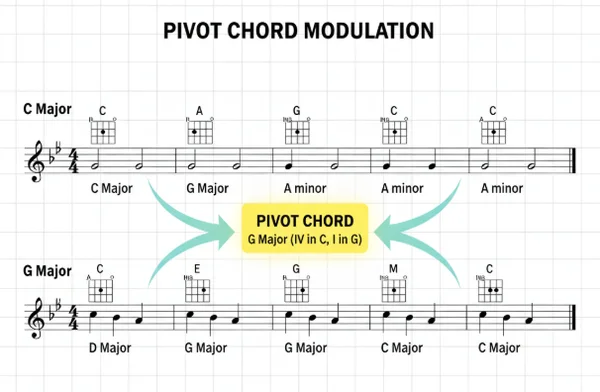
A pivot chord is a chord that exists in both the key you are leaving and the key you are entering. It acts as a "double agent." When the listener first hears it, they think it belongs to the old key. By the time the next chord plays, they realize it was actually the start of the new key.
The best pivot chords are usually found between keys that are close together on the circle. You can check chord relationships on our interactive map to see which chords are shared between keys like G Major and D Major.
Dominant and Leading-Tone Pivot Chords
While many chords can serve as pivots, some are more powerful than others. The Dominant (V) chord of the new key is the clearest way to establish a new tonic. Alternatively, the Leading-Tone (vii°) creates more tension, "pulling" the listener strongly toward the new key's home note.
Case Study: C Major to E Major Through A Major
Moving from C Major to E Major is a "bright" shift because you are adding four sharps. A great pivot chord here is A Major.
-
In C Major, the "A" chord is usually A minor. However, you can use a borrowed chord to play an A Major chord.
-
In the key of E Major, A Major is the IV chord.
-
By playing a progression like C -> G -> A -> B7 -> E, you use the A chord to bridge the gap. The B7 then "locks in" the new key.
Advanced Modulation Techniques for Contemporary Music
In modern pop, jazz, and film music, composers often want to move faster or more creatively. This is where advanced techniques come into play.
Sequential Modulation and Chain Modulation
Sequential modulation involves repeating a short melodic phrase at a different pitch level. If you repeat a pattern three times, each time a whole step higher, you are "sequencing" through keys.
Chain modulation takes this further by moving through the Circle of Fifths in a series of quick jumps. This creates a sense of constant motion and energy. You can explore chord progressions to see how moving by fourths or fifths can create a "cycle" that feels never-ending.
Deceptive Modulation and Unexpected Key Changes
Sometimes, the best key change is the one the listener doesn't see coming. A deceptive modulation happens when you prepare the listener for a specific key but then land on a chord from a different key entirely.
For example, you might build up a strong V7 chord in C Major (G7). The ear expects a resolution to C. Instead, you resolve it to an Ab Major chord. This "deceives" the ear and suddenly places you in a new harmonic world. This technique is common in modern film scores to highlight sudden plot twists.
Applying These Techniques to Your Compositions
To make these modulations work in your own music, keep these tips in mind:
- Smooth out the melody: Ensure your melody line doesn't jump too far when the key changes. A smooth melody can hide a complex key change.
- Watch your bass line: Use the bass to lead into the new tonic. A chromatic bass line is a great way to "glue" two keys together.
- Practice with tools: Use an interactive music tool to experiment with different "home" keys and see how they connect.
Masterful Modulation Starts Here
The Circle of Fifths is your most powerful ally in creating compelling, emotionally resonant compositions with seamless key changes. By mastering these modulation techniques, you'll open up new creative possibilities and elevate your compositions to professional levels.
Whether you're weaving between keys with a delicate common tone or building a strong pivot chord bridge, every modulation should serve the emotional journey of your composition. Smooth transitions allow your audience to stay immersed in your song without being distracted by technical "clunks."
Ready to transform your compositions with these modulation techniques? Explore our interactive tool and hear these key changes in action. Your musical journey awaits!

Frequently Asked Questions
How can I identify the best pivot chord for modulation?
The best pivot chord is one that is "diatonic" (natural) to both your current key and your target key. To find one, list the chords in Key A and Key B. Any chords that appear in both lists are potential pivots. You can also view chord lists on our website to see these relationships instantly for any key.
What's the difference between common-tone and pivot chord modulation?
Common-tone modulation uses a single shared note to bridge the keys. This often results in a more dramatic or "coloristic" shift. Pivot chord modulation uses a full shared chord. It typically feels more structurally stable and traditional. Pivot chords are most effective between keys that are close on the Circle of Fifths.
How long should a modulation typically last in a composition?
There is no hard rule, but "smooth" modulations usually take 2 to 4 bars to establish. This gives the listener's ear time to adjust to the new "home" note. In some genres, a modulation can happen instantly for maximum impact. To see how different lengths of transitions feel, you can test chord sequences on our interactive chart to hear the difference.