Jazz Improvisation Mastery: Circle of Fifths & Chord Substitutions Explained
Have you ever listened to a seasoned jazz musician and wondered how they create such rich, complex, and beautiful harmonies? It can feel like they know a secret language, effortlessly weaving through chord changes that sound both surprising and perfectly logical. How can you move beyond basic scales and unlock that same creative freedom in your own improvisation?
The answer is often hiding in plain sight, within a tool many musicians learn but few truly master: the Circle of Fifths. While it's great for understanding key signatures, its real power for a jazz musician lies in revealing the deep relationships between chords. Let's break down how to use it to master the core of jazz harmony and unlock sophisticated chord substitutions.
Forget staring at a static chart in a textbook. To truly grasp these concepts, you need to see, hear, and interact with them. That's where our powerful, our interactive Circle of Fifths comes in. We’ll guide you through the theory and show you exactly how to apply it, turning abstract ideas into tangible music.

Jazz Harmony Essentials: ii-V-I Progressions and the Circle of Fifths
Before we can bend the rules with substitutions, we need to understand the rules themselves. In jazz, the most important harmonic building block is the ii-V-I progression. It’s the engine that drives countless jazz standards, creating a satisfying sense of tension and release that is fundamental to the genre's sound.
Understanding this progression isn't just academic; it’s the key to navigating chord changes with confidence. Once you can spot a ii-V-I from a mile away, you'll start seeing the entire harmonic map of a tune differently. The Circle of Fifths is your perfect guide for this journey.
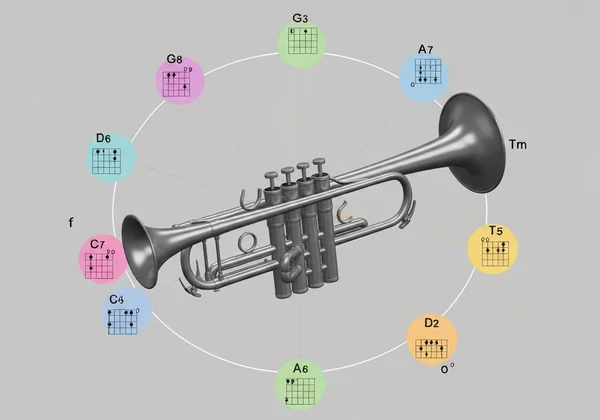
Deconstructing the ii-V-I: Jazz's Core Building Block
So, what exactly is a ii-V-I (pronounced "two-five-one")? It’s a sequence of three chords built on the second, fifth, and first degrees of a major scale. In the key of C Major, for example, the notes of the scale are C, D, E, F, G, A, B.
- The ii chord is built on the second degree (D), making it a D minor 7th (Dm7).
- The V chord is built on the fifth degree (G), making it a G dominant 7th (G7).
- The I chord is built on the first degree (C), making it a C major 7th (Cmaj7).
The progression is Dm7 → G7 → Cmaj7. The G7 chord builds harmonic tension craving resolution. The Cmaj7 delivers that release—a perfect ‘question and answer’ dynamic fundamental to jazz. Look at the Circle of Fifths, and you'll notice that G is right next to C, moving counter-clockwise. This movement of a perfect fifth is the strongest, most natural-sounding resolution in Western music.
Basic Voice Leading for Smooth Jazz Chord Changes
Playing the root position of these chords will sound technically correct, but it won't have that smooth, connected quality of professional jazz. That's where voice leading comes in. Voice leading means transitioning between chords smoothly. Instead of jumping between notes, find the closest tonal path—like how the F in G7 slides down to E in Cmaj7.
Instead of jumping your hand all over the piano or guitar, you find the closest possible notes to form the next chord. For example, when moving from G7 (G-B-D-F) to Cmaj7 (C-E-G-B), notice that the B and G are common tones. The F in the G7 chord just needs to move down a half-step to E, and the D moves down to C. This creates a seamless transition that sounds fluid and sophisticated.
Unleashing Creative Chord Substitutions with the Circle of Fifths
Once you're comfortable with the standard ii-V-I, it's time to add some color. Chord substitutions are the secret to that classic, rich jazz sound. Instead of playing the expected chord, you substitute it with a different one that serves a similar harmonic function but adds a new flavor. The Circle of Fifths is your ultimate map for finding these substitutions.
This is where your playing evolves from simply outlining the changes to actively shaping the harmony. It’s a creative process that allows you to put your unique stamp on any tune, and the Circle makes it intuitive.
Tritone Substitution Explained: The Jazz Sound Defined
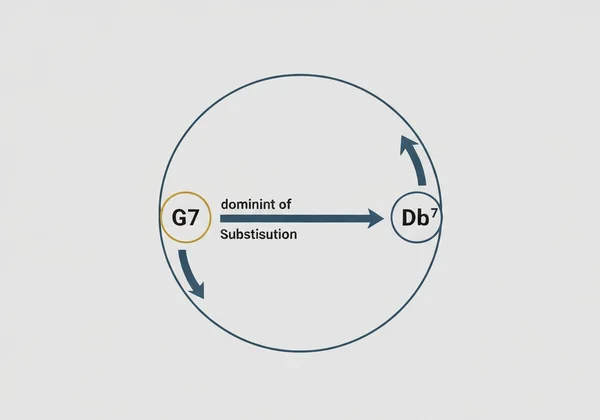
The most common and powerful substitution in jazz is the tritone substitution. It specifically targets the V chord (the dominant 7th) in a ii-V-I progression. The rule is simple: you can replace any dominant 7th chord with another dominant 7th chord whose root is a tritone away.
A tritone is an interval of three whole steps. For our G7 chord, a tritone away is Db7. So, instead of playing Dm7 → G7 → Cmaj7, you can play Dm7 → Db7 → Cmaj7.
Why does this work? Because G7 and Db7 share the same two most important notes—the 3rd and the 7th (the "guide tones").
- The 3rd and 7th of G7 are B and F.
- The 3rd and 7th of Db7 are F and Cb (which is enharmonically the same as B).
They contain the same tension notes, so they both resolve beautifully to Cmaj7. The substitution creates a smooth, chromatic bassline movement (D → Db → C), which is a hallmark of the jazz sound. On the Circle of Fifths, you can find a tritone substitution instantly: it's the chord directly opposite the one you want to replace.
Dominant 7th Chords and Their Substitutions
The V chord is almost always a dominant 7th, making it the perfect candidate for substitution. The Circle of Fifths elegantly displays the relationship between a dominant chord and its target. The V chord (like G7) sits right next to its I chord (Cmaj7).
When you use the tritone substitution, you are essentially borrowing a chord from the opposite side of the circle. This creates a much more dramatic harmonic pull. Exploring these relationships is key to developing your harmonic vocabulary. The best way to internalize this is to see it visually and hear it in action. You can visualize these relationships on our interactive chart to see how dominant chords connect to their resolutions, both standard and substituted.
Applying Jazz Substitutions with Our Interactive Circle of Fifths Tool
Theory is useless until you can apply it to your instrument. The true breakthrough comes when you can move these concepts from your head to your hands. Our interactive Circle of Fifths is designed for exactly this purpose—to be your digital practice partner.
It bridges the gap between abstract knowledge and musical application. You can instantly see chord relationships, hear how substitutions sound, and experiment with new harmonic ideas in a way that static diagrams simply can't match.

Step-by-Step: Using Our Interactive Circle to Find Substitutions
Let's make this incredibly simple. Here is how you can use our tool to find tritone substitutions in seconds:
- Open the Tool: Navigate to the interactive Circle of Fifths.
- Pick Your Key: Click on any major key on the outer wheel. Let's choose Eb Major. The tool will instantly highlight the key and show you all its diatonic chords.
- Identify the V Chord: Look at the chord list. The V chord in Eb Major is Bb7.
- Find the Tritone Sub: On the interactive circle, find Bb. Now, look directly across the circle. You’ll see E. This means E7 is the tritone substitute for Bb7.
- Listen and Compare: Use the tool's audio feature to click on the V chord (Bb7) and then its substitute (E7). Hear how they both create tension that wants to resolve to Ebmaj7.
By using the tool this way, you're not just memorizing a rule; you're building an intuitive understanding of harmonic function.
Practice Exercises: From Theory to Fluid Jazz Lines
Now, let's turn this knowledge into music. Here are a few exercises you can do with our tool:
- Substitution Drill: Pick a jazz standard you know, like "Autumn Leaves" or "All the Things You Are." Go through the chord chart and identify every V7 chord. Use the tool to find its tritone substitute and write it down.
- Comping Practice: Play through the tune on your instrument. The first time, use the original V7 chords. The second time, play it using only the tritone substitutions. Notice the difference in the feel and the sound of the bass motion.
- Improvisation Challenge: Record yourself playing the backing chords with the substitutions. Now, try to improvise over them. The scales you use over the substituted chord will be different, opening up new melodic possibilities. This is how you start building truly unique and interesting jazz lines.
Ready to Unlock Real Jazz Fluency?
Jazz fluency isn’t about endless practice—it’s about strategic experimentation. Use substitutions to surprise listeners (and yourself!) with harmonies that feel fresh yet inevitable. Grab your instrument, open our interactive Circle of Fifths, and start experimenting with substitutions today. Trust us—those ‘aha’ moments are just a few clicks away.
Frequently Asked Questions About Jazz Improvisation & the Circle of Fifths
How does the Circle of Fifths simplify complex jazz harmony?
The Circle of Fifths simplifies jazz harmony by providing a visual map of key relationships. It organizes all 12 keys in a logical sequence of perfect fifths. This layout makes it easy to spot fundamental patterns like the ii-V-I progression, identify relative minors, and understand how quickly a tune might modulate from one key to another.
What is a tritone substitution and how does it relate to the Circle of Fifths?
A tritone substitution is a common jazz technique where a dominant 7th chord is replaced by another dominant 7th chord whose root is three whole steps (a tritone) away. The Circle of Fifths makes finding these incredibly easy: the substitute chord is always located directly opposite the original chord on the circle. For example, G7's substitute, Db7, is right across from it.
How can I practice jazz improvisation with Circle of Fifths concepts?
Start by focusing on one key at a time using the circle as your guide. Practice playing the ii-V-I progressions in that key until they become second nature. Then, use the circle to identify the tritone substitute for the V chord and practice the progression with that new chord. This will help you internalize the sound and feel of these advanced harmonies.
Can this tool help me find advanced jazz chord progressions?
Absolutely. Our interactive tool is perfect for this. When you click on a key, it instantly shows you the primary diatonic chords. From there, you can easily identify the V chord and look directly across the circle to find its tritone substitute. Experimenting with these substitutions is the first step to creating and understanding more advanced jazz progressions. You can explore jazz chord substitutions and hear them instantly with our tool.