Circle of Fifths: Your Visual Map for Scales & Intervals
Struggling to memorize the endless combinations of music scales and intervals? For many musicians, from students to seasoned songwriters, music theory can feel like an abstract puzzle. What if you could transform that complex theory into an intuitive visual map, making learning effortless? The circle of fifths is that map, and with a modern interactive approach, it becomes the most powerful tool in your musical arsenal. Stop rote memorization and start seeing the connections with our interactive tool.
Unlocking Music Theory Fundamentals with the Circle of Fifths
Before you can build soaring melodies or compelling chord progressions, you need a solid grasp of music theory fundamentals. The circle of fifths organizes all 12 chromatic pitches in a sequence of perfect fifths, creating a master diagram for musical relationships. It’s not just a chart to memorize; it's a logical system that reveals the underlying structure of Western music, making concepts like key signatures and harmony incredibly easy to understand.
What is the Circle of Fifths and How Does it Map Scales?
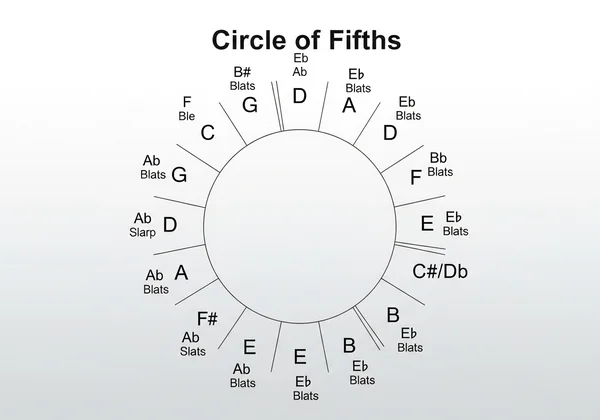
At its core, the circle of fifths is a visual representation of the relationships between the 12 tones of the chromatic scale. Starting from C at the top, moving clockwise adds one sharp to the key signature with each step (C to G, G to D, and so on). Moving counter-clockwise adds one flat with each step (C to F, F to Bb, etc.). This simple, predictable pattern is the key to unlocking how music scales are constructed. It shows you not just what notes are in a scale, but why they belong together.
Navigating Key Signatures & Relative Minors Visually
One of the biggest hurdles for music students is memorizing key signatures. How many sharps are in B Major? How many flats are in Ab Major? Instead of relying on flashcards or mnemonics, the circle gives you the answer instantly. The number of steps you take from C tells you the number of sharps or flats. For example, E Major is four steps clockwise from C, so it has four sharps. This visual method is far more intuitive.
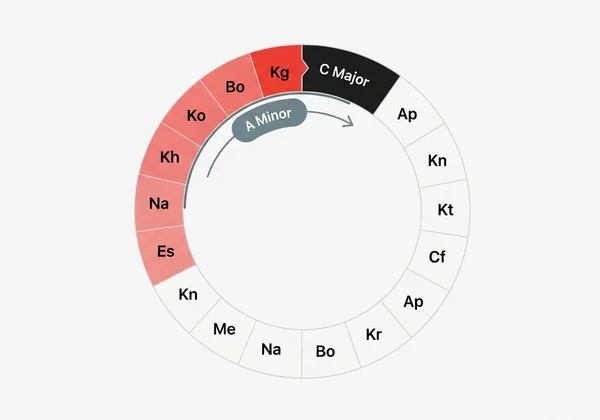
Furthermore, finding a key's relative minor becomes a simple visual task. The relative minor shares the exact same key signature as its major counterpart. On the circle, it’s located just inside the major key. Look at C Major; its relative minor is A minor. Look at G Major; its relative minor is E minor. This immediate visual connection helps you understand tonality on a deeper level. You can explore the circle to see these relationships instantly.
Mapping All Music Scales: Major and Minor on the Circle
The true power of the circle of fifths shines when you use it as a map for building scales. Every major and minor scale is embedded within its structure, waiting to be discovered. Once you see the pattern, you'll never need to guess the notes in a scale again.
Discovering Major Scales through the Circle's Clockface
Think of the circle as a blueprint for scale construction. To find the notes in any major scale, simply take the note of the key you're in, the two notes to its left (counter-clockwise), and the three notes to its right (clockwise), plus the note directly across from your key. Let's try it for G Major:
-
The root is G.
-
The three clockwise neighbors are D, A, and E.
-
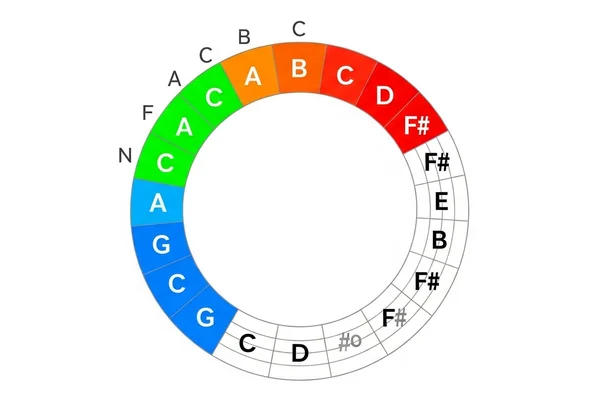
The two counter-clockwise neighbors are C and F. Wait, the G major scale has an F#! The note directly across from G is Db, but a half step up from there is D, which we already have. A better method is to take the root note and the six notes immediately adjacent to it clockwise. For G Major, this would be G, D, A, E, B, F#, C#. Rearrange them, and you get G-A-B-C-D-E-F#—the G Major scale! Our visual map simplifies this even further by highlighting the scale for you.
Understanding Minor Scales & Their Relationships to Major Keys
Since every major key has a relative minor that shares the same notes, the circle of fifths is also your guide to all natural minor scales. To find the notes of A minor, you can simply use the notes of its relative major, C Major (C-D-E-F-G-A-B). This direct interval relationship between major and minor keys is fundamental to songwriting and improvisation. By understanding this connection, you can effortlessly switch between moods and create more dynamic music.
Visualizing Music Intervals & Chord Construction
Beyond scales, the circle of fifths is an indispensable tool for understanding harmony. The distances between notes on the circle represent crucial music intervals, which are the building blocks of chords and melody. This visual guide helps you internalize these relationships, training both your mind and your ear.
Identifying Intervals and Degrees Within Any Scale
The most obvious interval on the circle is the perfect fifth—the distance between any two adjacent notes moving clockwise. Moving counter-clockwise gives you a perfect fourth. A whole step (major second) is two positions away on the circle (e.g., C to D). By counting the steps, you can begin to visualize the distance between scale degrees without needing to count semitones on a keyboard. This skill is vital for improvisation and composing melodies that fit the underlying chords.
Building Diatonic Chords from the Scales on the Circle
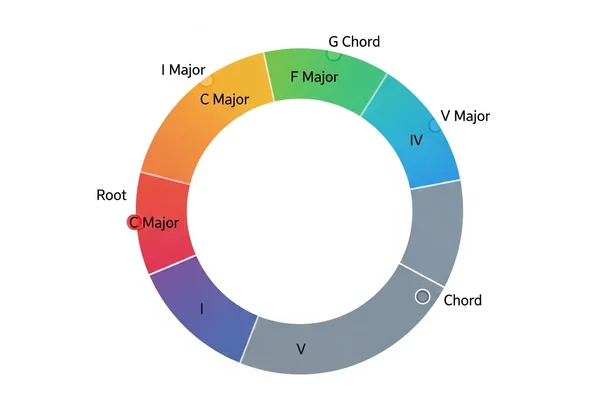
Want to know which chords belong in a key? The circle makes it easy. The three primary chords in any major key (the I, IV, and V chords) are always found in a tight cluster. Your root (I) is in the center, flanked by its neighbors—the IV chord to the left and the V chord to the right. For example, in the key of C Major, the primary chords are F (IV), C (I), and G (V). The three main minor chords (ii, iii, vi) are also grouped together. This visual grouping is the secret to writing great chord progressions that sound natural and resolved. Try our free tool to see these diatonic chords light up instantly.
Interactive Learning with Our Tool: Your Practical Guide
Reading about the circle of fifths is one thing, but experiencing it interactively is what truly solidifies the concepts. Static charts in textbooks can be confusing and inert. Our goal with the interactive Circle of Fifths tool was to bring this powerful diagram to life, turning it from a theoretical object into a practical, hands-on learning instrument.
Step-by-Step: Using Our Tool to Explore Key Signatures and Scales
Our platform is designed for intuitive exploration. When you visit the homepage, you're greeted with a large, clear circle. Here’s how to use it:
- Click any key: Select any major or minor key on the outer or inner ring.
- See the magic: The tool instantly highlights the selected key, its relative key, and all the diatonic chords that belong to it.
- Get the details: Below the circle, a table displays every chord in the key, along with the notes of the corresponding scale. This immediate feedback loop answers questions like "What are the chords in G major?" in a fraction of a second. You can practice with our tool to build muscle memory for these crucial relationships.
Leveraging Audio Playback and Custom Views for Deeper Understanding
To bridge the gap between theory and sound, our interactive circle includes audio playback. Click on any chord in the table to hear how it sounds, connecting the visual pattern to the auditory experience. This feature is invaluable for ear training and helps you internalize the feel of different chords within a key.
Additionally, you can customize your view to suit your learning needs. Switch between different clefs (treble, bass, etc.) or hide the key signatures to quiz yourself. This active recall method is one of the most effective ways to learn. You can even export the diagram as a PDF for offline study, making it a versatile tool for students, teachers, and composers alike.
Master Scales & Intervals with Your Interactive Circle of Fifths
The circle of fifths is more than just a diagram; it's the Rosetta Stone of music theory. It demystifies key signatures, simplifies scale construction, illuminates chord relationships, and provides a visual framework for harmony. By transforming these abstract concepts into a clear and logical map, it empowers you to learn faster, write better music, and improvise with confidence.
Don't let music theory be a barrier to your creativity. It's time to stop memorizing and start understanding. Explore the interactive Circle of Fifths today, and see for yourself how this timeless tool can revolutionize your musical journey.
Frequently Asked Questions About the Circle of Fifths for Scales & Intervals
How to use the Circle of Fifths to find major and minor scales?
To find a major scale, select your root note on the circle. The notes of the scale are typically clustered around it. For an even easier way, our interactive circle instantly displays all the notes of the major scale when you click on a key. To find a natural minor scale, simply find its relative major key on the outer circle; they share the exact same notes.
What is the Circle of Fifths used for in understanding intervals?
The circle visually represents musical intervals. Adjacent keys clockwise are a perfect fifth apart, while adjacent keys counter-clockwise are a perfect fourth apart. This helps you see the harmonic distance between notes, which is crucial for building chords, writing melodies, and understanding the foundation of Western harmony.
How can I memorize key signatures using the Circle of Fifths?
The circle is the ultimate tool for this. Starting from C (no sharps/flats), each step clockwise adds one sharp, and each step counter-clockwise adds one flat. The position on the circle tells you the number of accidentals. For example, A Major is three steps clockwise, so it has three sharps. This visual method is far more effective than rote memorization.
Can the Circle of Fifths help me find chords in any key?
Absolutely. The chords that belong to any given key (diatonic chords) are grouped together on the circle. For any major key, its IV and V chords are its immediate neighbors. Our tool makes this effortless; click any key, and it will instantly highlight the I, ii, iii, IV, V, and vi chords, giving you the complete harmonic palette for that key. You can visualize key signatures and chords right now.