Circle of Fifths Mistakes to Avoid: 7 Common Errors
Are you struggling to understand the circle of fifths despite staring at it for hours? You’re not alone. Music students, songwriters, and instrumentalists often fall into the same traps when using this foundational tool. In this guide, we reveal seven sneaky mistakes that stagnate learning – and how our interactive tool turns confusion into clarity.
Confusing Relative Minor and Parallel Minor
Many musicians incorrectly treat relative and parallel minors as interchangeable concepts. Here’s the critical difference:
- Relative minor: Shares the same key signature as its major counterpart (e.g., A minor is relative to C major).
- Parallel minor: Shares the same tonic note but uses a different key signature (e.g., C minor vs. C major).
Our visual highlighting system solves this confusion. When you click any major key on our interactive circle, the relative minor automatically illuminates, creating an unmistakable visual distinction from parallel minors.
Misinterpreting Key Signature Order
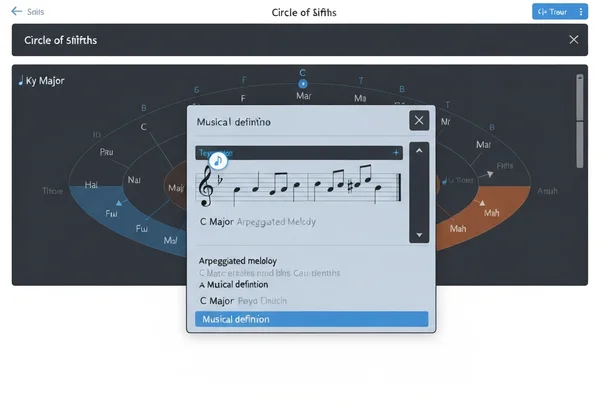
Clockwise vs. counterclockwise confusion leads to incorrect key signature recall. The circle adds sharps when moving clockwise (C→G→D) and flats counterclockwise (C→F→B♭). Yet novices often reverse this logic.
Our tool’s toggle feature teaches proper navigation. Explore the circle and watch how:
- Clockwise clicks trigger "+1 sharp" animations
- Counterclockwise clicks show "+1 flat" overlays
- Key signature changes display in real-time as you rotate
Overlooking Chord Function Within Keys
Beginners often memorize chord positions (I-IV-V) without grasping their functional relationships – like using a V chord when resolution is needed.
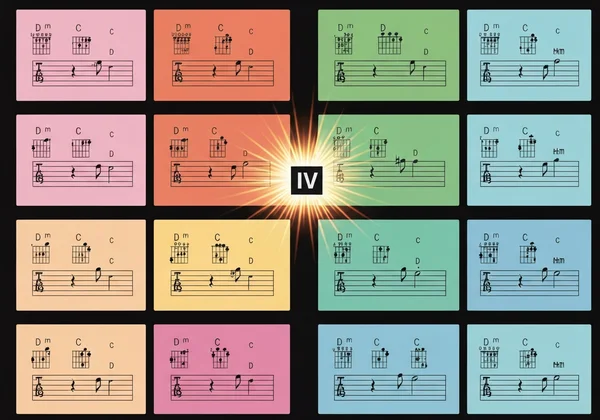
Our color-coded chord system reinforces function:
- Blue: Tonic (home base)
- Green: Subdominant (movement away)
- Red: Dominant (tension building)
Click any chord on our interactive chart to hear its function. The tool plays the chord progression I→[selected chord]→I, helping you internalize how each chord feels within a key.
Forgetting Modulation Possibilities
Modulation phobia stems from not seeing adjacent key relationships. The circle’s greatest strength? Showing that G major naturally flows to either C (clockwise) or D (counterclockwise) major.
Try our modulation assistant:
- Select your starting key
- Activate the "Modulation Map"
- Watch neighboring keys highlight based on compatibility
- Click any linked key to hear seamless transitional chords
Ignoring the Relationship Between Major and Relative Minor
Key signature blindness occurs when students memorize scales in isolation. The circle reveals that E major and C♯ minor share identical accidentals – a relationship hidden in traditional theory books.
Turn on Parallel Mode on our platform to:
- Display all major/minor pairs side-by-side
- Highlight shared chord tones between relatives
- Play modal mixture progressions with one click
Misunderstanding the Circle’s Practical Applications
Many treat the circle as just a key signature cheat sheet, missing its creative potential. Did you know it can:
- Generate chord progressions for songwriting
- Map out guitar capo positions
- Plan key changes for vocal-friendly arrangements
Our songwriting lab demonstrates this through:
- A built-in "Progressions Generator" using circle geometry
- Auto-transposition tools maintaining harmonic relationships
- Piano and guitar visualizers that make applying the circle of fifths on guitar simple
Neglecting to Practice with the Tool Regularly
Passive observation creates fragile knowledge. True mastery requires active recall – precisely why static circle of fifths charts fail.
Our platform’s Practice Mode turns learning into an engaging drill:
- Enable hidden key signatures
- Get quizzed on relative minors/dominant chords
- Track your accuracy score
- Challenge yourself with timed identification drills
Repeated use creates neural pathways through sound, sight, and touch – something impossible with paper diagrams.

Experience Music Theory in Action
The circle of fifths isn’t meant to be memorized – it’s meant to be experienced. Traditional learning fails because it treats music theory as static information, not a living system.
Our interactive tool solves this by:
- Turning abstract relationships into clickable soundscapes
- Providing instant feedback on musical choices
- Creating personalized practice sessions
- Destroying the myth that theory must be boring
Stop struggling with music theory. Experience the circle properly – and create your first song with confidence today.**
Circle of Fifths Mistakes FAQ
1. How long does it take to stop making circle of fifths mistakes? With daily interactive practice, most users see dramatic improvement in 2-3 weeks. Our built-in drills accelerate pattern recognition faster than textbook study alone.
2. Can the circle help me identify song keys? Absolutely! Our tool includes a Key Finder that analyzes chord progressions against circle relationships. Try it free with your latest song idea.
3. Is confusing relative/parallel minor a serious error? It’s the #1 cause of chord progression errors. Our visual differentiation system eliminates this confusion through specific highlighting and auditory examples.
4. Do professional musicians actually use the circle? Top producers and performers use it daily – often through tools like ours. It is essential for composing complex harmonies and modulations quickly.
5. Can I use your tool on mobile during rehearsals? Yes! Our fully responsive design works flawlessly on phones. Jazz musicians especially love using it for on-the-fly transposition during jam sessions.