Circle of Fifths Mastery: Using Chord Substitutions for Jazz Improvisation
Jazz improvisation often feels like an insurmountable wall for intermediate musicians—endless scales, confusing chord changes, and the pressure to create meaningful melodic ideas on the spot. Many players find themselves stuck, repeating the same patterns without understanding the rich harmonic language of jazz.
But what if there were a systematic way to navigate this complex landscape using one simple visual tool? What if you could transform your jazz playing from uncertain to confident, unlocking new levels of creativity?
Discover how the Circle of Fifths unlocks the secrets of jazz improvisation and chord substitutions. We will show you how this powerful diagram is more than just a theory concept; it's a practical map for jazz exploration. With the help of an interactive tool, you can turn abstract ideas into concrete sounds, accelerating your journey toward improvisation mastery.

Understanding the Jazz Improvisation Foundation
Before diving into advanced techniques, it's essential to understand why jazz harmony can feel so intimidating. You don't need to memorize every possible chord. Instead, focus on seeing the patterns and relationships that connect them. This is where the Circle of Fifths becomes your most valuable ally.
Why Jazz Chord Progressions Seem Overwhelming
Jazz standards are famous for their sophisticated chord progressions. They move through multiple keys, use complex chords with extensions (like 7ths, 9ths, and 13ths), and often change chords every two beats. For a musician used to simpler pop or rock structures, this can feel like trying to read a foreign language.
Jazz harmony is dynamic and rarely stays in one key for long. Composers use techniques like secondary dominants, related ii-V's, and modal interchange to create tension and resolution. Without a mental framework to organize these concepts, improvisers can easily get lost, unsure of which scales or arpeggios to play over each chord. This often leads to playing "safe" notes instead of creating truly expressive melodic lines.
The Circle of Fifths as Your Jazz Roadmap
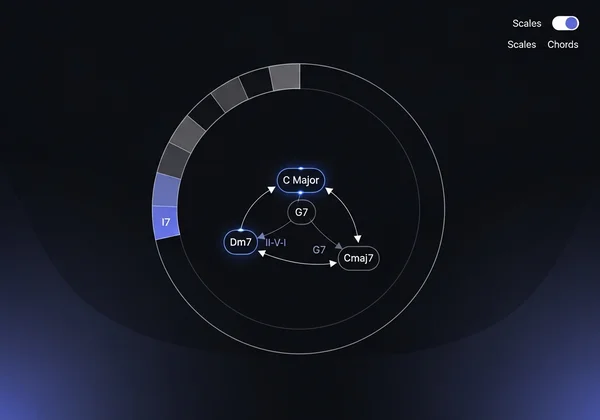
The Circle of Fifths is the perfect tool to demystify jazz harmony. At its core, it organizes all 12 musical keys by their relationship in perfect fifths. This visual layout immediately reveals fundamental patterns that are the building blocks of jazz. For example, the powerful ii-V-I progression, the backbone of countless jazz tunes, appears as a simple adjacent sequence on the circle.
Instead of a random collection of chords, the circle shows you a logical system. It helps you see how keys relate to each other, making modulation (changing keys) predictable. By using our interactive chart, you can click on any key and instantly see its related chords and scales. This visual and auditory feedback makes the connections between chords tangible, transforming the circle from a static image into a dynamic, explorable map for your improvisations.
Mastering Chord Substitutions with the Circle of Fifths
Chord substitutions are the heart and soul of jazz harmony. They involve replacing a standard chord in a progression with another that serves a similar function but adds a different color or flavor. This is what gives jazz its characteristic harmonic richness and unpredictability. The Circle of Fifths is your key to finding and understanding these powerful substitutions.
Tritone Substitutions: The Jazz Player's Secret Weapon
One of the most common and effective substitutions in jazz is the tritone substitution. This technique involves replacing a dominant 7th chord with another dominant 7th chord whose root is a tritone (three whole steps) away. For example, a G7 chord can be replaced by a Db7 chord.
Why does this work? Because both G7 and Db7 share the same two crucial notes—the 3rd and the 7th (B and F in G7; F and Cb/B in Db7). These notes, called "guide tones," define the chord's function and create the tension that needs to resolve. You can easily find any tritone substitution on the Circle of Fifths by looking directly across the circle. For instance, G is directly opposite Db. Using a visual tool makes finding these pairs instant and effortless.
Extended Dominants and the Circle's Diagonal Relationships
Extended dominants, also known as secondary dominants, are dominant chords that temporarily lead to a chord other than the tonic (the "I" chord). They create a strong sense of forward motion. For example, in the key of C Major, the V chord is G7, which resolves to C. A secondary dominant might be an A7 chord, which acts as the "V of ii" and resolves to Dm7.
The Circle of Fifths makes finding these relationships incredibly simple. To find the dominant of any chord, just move one step clockwise on the circle. For example, starting from D (for the Dm7 chord), one step clockwise is A (for the A7 chord). You can create long chains of these dominant resolutions by moving clockwise around the circle, a common device in jazz tunes like "All the Things You Are."
ii-V-I Variations: Building Your Substitution Vocabulary
The ii-V-I progression is the most fundamental cadence in jazz. In C Major, this would be Dm7 - G7 - Cmaj7. Jazz musicians constantly reharmonize this progression to add interest. A common variation involves preceding the ii chord (Dm7) with its own secondary dominant.
Using the circle, you can trace this backward. The ii chord is Dm7. Its dominant (V) is A7. The dominant of A7 is E7, and so on. This allows you to create a "chain" of dominants leading to your target chord. Another popular substitution is to replace the ii-V with its tritone substitute. Instead of Dm7 - G7, you could play Abm7 - Db7 before resolving to Cmaj7. Exploring these relationships on an interactive circle helps solidify these concepts in your ear and mind.
Practical Application: Implementing Substitutions in Real Jazz Standards
Theory is only useful when you can apply it to real music. Let's analyze how these substitution techniques work in two famous jazz standards. By breaking down these tunes, you'll see how the Circle of Fifths provides a clear lens for understanding and creating sophisticated improvisations.
Analyzing "Autumn Leaves" Through the Circle's Lens
"Autumn Leaves" is a perfect standard for beginners because its chord progression is largely based on movement around the Circle of Fifths. The A section (in the key of G Major) moves through Am7 - D7 - Gmaj7 - Cmaj7 - F#m7b5 - B7 - Em.
Notice the patterns here. Am7 - D7 - Gmaj7 is a clear ii-V-I in G Major. You can see this G-D-A cluster on the circle. The progression then moves to a ii-V in the relative minor key (E minor): F#m7b5 - B7 - Em. Again, you can see this E-B-F# relationship on the circle. By viewing the progression this way, you're not just memorizing chords; you're seeing logical harmonic movements that you can apply to your solos.
Creating Substitution Patterns for "All the Things You Are"
"All the Things You Are" is famous for its constant key changes, which can be daunting. However, the Circle of Fifths reveals the tune's elegant logic. The song moves through a series of keys that are a fourth apart, which corresponds to moving counter-clockwise around the circle (Ab -> Db -> Gb -> Cb/B -> E -> A -> D -> G).
This structure is a goldmine for applying substitutions. For each ii-V-I, you can practice applying a tritone substitution. For example, the opening progression Fm7 - Bb7 - Ebmaj7 could become Fm7 - E7 - Ebmaj7. You could also extend the progressions with secondary dominants. The clear, visual layout of our free music theory tool can help you map out these substitutions before you even play them, giving you a clear plan for your improvisation.
Your Jazz Improvisation Transformation Journey
Jazz improvisation doesn't have to be a mystery. By using the Circle of Fifths as your guide, you can unlock the logical and beautiful structure that underpins even the most complex jazz standards. We've seen how this single diagram helps you understand overwhelming progressions, master powerful chord substitutions, and apply these concepts to real music.
Here's what you'll take away from this exploration:
- The Circle of Fifths is a roadmap that simplifies complex jazz harmony.
- Techniques like tritone substitutions and extended dominants are easily found on the circle.
- Analyzing standards through the lens of the circle reveals the logic behind their progressions.
Your journey to jazz mastery is a practical one. Theory is just the beginning. The real magic happens when you apply these concepts to your instrument. That's why we built our interactive tool. It allows you to see, hear, and experiment with these harmonic relationships in real-time.
Ready to transform your playing? Visit CircleOfFifths.io now to explore chord progressions, discover substitutions, and turn theory into music.
The Takeaway
How does the Circle of Fifths help with jazz improvisation?
The Circle of Fifths provides a visual map of key relationships. It helps you instantly see common jazz progressions like the ii-V-I, find secondary dominants (by moving clockwise), and identify tritone substitutions (by looking across the circle). This turns abstract theory into a practical guide for your solos.
What are the most common chord substitutions in jazz?
The two most essential substitutions are the tritone substitution (e.g., replacing G7 with Db7) and the use of secondary dominants (e.g., adding an A7 before a Dm7 chord). Many other variations, like using diminished chords or modal interchange, are also common, but these two are fundamental building blocks.
Can the Circle of Fifths help me memorize jazz standards?
Absolutely. Instead of memorizing a long list of random chords, the circle helps you see the underlying patterns in a tune's harmony. You'll start recognizing ii-V-I's, cycles of fourths, and key changes, which groups chords into logical chunks that are much easier to remember. You can test your memory with the interactive circle by hiding the key signatures.
How do I practice chord substitutions effectively?
Start with one standard you know well. Using a tool like the Circle of Fifths, identify all the V7 chords. For each one, practice improvising over the progression first with the original chord, then with its tritone substitute. Listen carefully to the difference and how your melodic ideas need to adapt.
What's the relationship between the Circle of Fifths and modal jazz?
While modal jazz (like Miles Davis's "So What") focuses on static harmony and scales (modes) rather than functional chord progressions, the Circle of Fifths is still useful. It helps you understand the parent key of each mode and can be used to create harmonic interest when moving between different modal sections.