Circle of Fifths Bass: Unlock Walking Bass & Chord Progressions
Are you a bass player who feels stuck just playing root notes? Do you find it hard to create smooth transitions between chords or feel lost when the music moves out of a simple key? If you're ready to break free from basic patterns and truly understand the fretboard, the Circle of Fifths is your secret weapon.
Many bassists learn the fundamental role of holding down the low end, but they struggle to connect music theory to what their fingers should be doing. This can make creating dynamic bass lines, understanding chord functions, and navigating key changes feel like a mystery. The result is playing that feels repetitive and uninspired.
This guide is here to change that. We will demystify the Circle of Fifths and show you exactly how to use it to master chord progressions and craft compelling walking bass lines. Our interactive tool lets you see, hear, and apply these ideas. Watch your playing go from basic to pro-level.
Mastering Bass Chord Progressions with the Circle of Fifths
Think of the Circle of Fifths as a map of musical harmony. For a bass player, it’s the ultimate cheat sheet for understanding how chords relate to one another. Instead of seeing chords as random letters on a page, the Circle shows you the strong, natural relationships between them, allowing you to anticipate changes and build a solid harmonic foundation.
Understanding Diatonic Chords & Functions on Bass
Every major or minor key has a family of seven chords that sound good together. These are called diatonic chords. As a bassist, your job is to outline this harmony. The three most important chords are the I (tonic, the "home" chord), the IV (subdominant), and the V (dominant, the chord that creates tension and leads back home).
The Circle of Fifths brilliantly organizes these relationships. If you pick any key on the circle:
- The key to its right (clockwise) is its V chord (dominant).
- The key to its left (counter-clockwise) is its IV chord (subdominant).
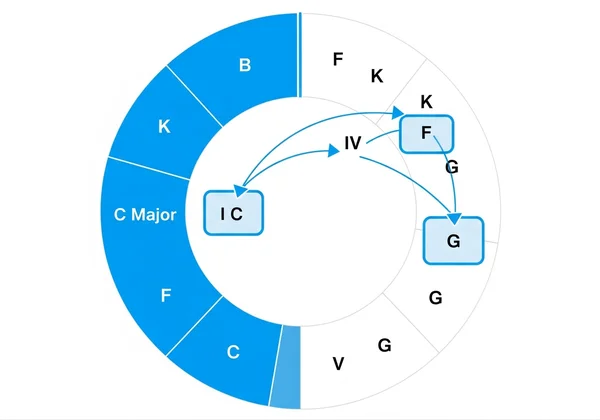
For example, find C Major on the circle. To its right is G (the V chord) and to its left is F (the IV chord). This simple visual trick instantly gives you the three most common chords in any key. You can see this in action by using our free online tool. Just click any major key, and it will instantly highlight the primary chords you need to know.
Navigating Root Notes Across the Bass Fretboard
Theory is great, but it means nothing until you can apply it to your instrument. The Circle maps root note moves on bass. Clockwise: fifths (C to G). Counter-clockwise: fourths (C to F). These are the smoothest moves in music.
Here’s a practical exercise:
- Go to the interactive Circle of Fifths and click on D Major.
- The tool will show you that its V chord is A and its IV chord is G.
- On your bass, find the root note D. Now, find A and G.
- Play a simple pattern: D - G - A - D.
You’ve just played a I-IV-V-I progression, one of the most famous patterns in music, and the Circle helped you find it instantly. By practicing this in different keys, you’ll start to see the Circle’s patterns all over your fretboard.
Crafting Smooth Walking Bass Lines Using the Circle
Walking bass lines are the heart of genres like jazz, blues, and swing. They do more than just play the root note; they create a melodic line that connects the chords together smoothly. The Circle of Fifths is the perfect guide for building these lines because it shows you the most logical paths from one chord to the next.
Deconstructing the ii-V-I Progression on Bass
The ii-V-I progression (pronounced "two-five-one") is arguably the most important chord sequence in jazz and pop music. It creates a powerful sense of tension and release that leads the listener’s ear back home to the tonic (I) chord.
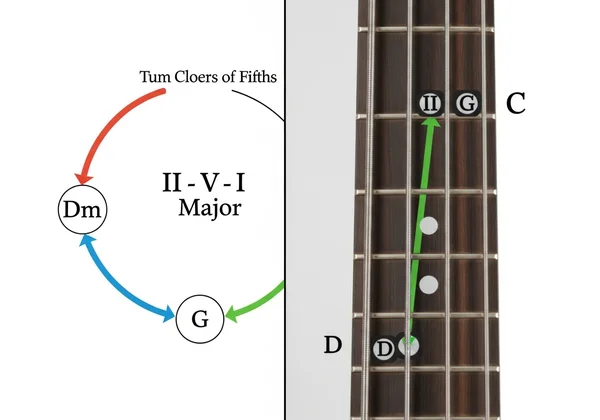
The Circle of Fifths makes finding a ii-V-I incredibly easy. Let's find it for the key of C Major:
- Find your target I chord, which is C.
- The V chord is one step clockwise: G.
- The ii chord is one step clockwise from the V chord: D. (In a major key, the ii chord is always minor, so it's Dm).
There it is: Dm - G - C. This three-chord pattern appears in countless songs. As a bassist, you can emphasize this movement by playing the root notes D, G, and C. Once you’re comfortable, you can start adding passing notes to "walk" between them. You can explore progressions for any key with our tool to see and hear this fundamental pattern.
Smoothly Connecting Chords: Bass Transitions & Turnarounds
Great bass playing is all about smooth transitions. You want to lead the band and the listener from one chord to the next without any jarring jumps. The Circle of Fifths often reveals the smoothest path. Moving counter-clockwise around the circle creates a strong pull, as each chord resolves down a perfect fifth.
For example, a common turnaround progression is iii-vi-ii-V-I. In the key of C, this would be Em - Am - Dm - G - C. Notice how Am, Dm, G, and C follow a neat counter-clockwise path on the circle.
When you see a chord chart, try tracing the root movements on the Circle of Fifths. You will quickly discover that most progressions follow predictable patterns around the circle. This lets you build bass lines that support chords. Plus, they boost the song's groove.
Practical Application: Circle of Fifths for Bass Improvisation
Improvisation can seem intimidating, but it's really just about making melodic choices that fit the underlying harmony. The Circle of Fifths provides the harmonic context you need to make smart, musical choices on the fly. It tells you which notes and chords belong together, giving you a framework for your creativity.
Identifying the Key of a Song for Bass Improvisation
Before you can improvise, you need to know what key you're in. The key signature (the sharps or flats at the beginning of the music) tells you the answer, and the Circle of Fifths is the ultimate decoder.
Instead of memorizing rules, you can simply use an interactive tool. Click on any key on the interactive Circle of Fifths tool, and it instantly displays the correct key signature. This allows you to quickly identify the key of a song, so you know which scale to use for your bass fills and solos. For example, if you see two sharps (F# and C#) on your sheet music, a quick look at the tool confirms you're in the key of D Major.
Practicing Bass Lines with Our Interactive Circle of Fifths Tool
This is where theory becomes practice. Our interactive tool isn't just a static chart; it's a dynamic practice partner. Here is a simple routine to get started:
- Open the interactive Circle of Fifths on your screen.
- Choose a key you want to work on, like E♭ Major.
- The tool will instantly show you all the diatonic chords in that key (E♭, Fm, Gm, A♭, B♭, Cm, Ddim).
- Click on the chords listed below the circle to hear what they sound like. This trains your ear to recognize the harmony.
- With your bass in hand, play the root notes of a ii-V-I progression in E♭: Fm - B♭ - E♭.
- Try walking between the root notes using notes from the E♭ major scale.
- Experiment with other progressions, like I-vi-IV-V (E♭ - Cm - A♭ - B♭).
Use the tool to link it all: the circle's visuals, chord sounds, and fretboard feel.

Your Next Steps to Unleash Your Bass Potential
The Circle of Fifths isn't just a complex diagram for music theory exams; it is a practical roadmap for every bassist who wants to play with creativity and confidence. By understanding its patterns, you can unlock powerful chord progressions, build fluid walking bass lines, and improvise with purpose.
You've learned how the circle visualizes chord functions, guides you across the fretboard, and provides the logic for timeless progressions like the ii-V-I. The key is to move from reading about it to actively using it.
Stop guessing which notes will work and start understanding the harmony. Time to turn theory into killer lines. Pick up your bass and try it. Go to our interactive Circle of Fifths tool, pick a key, and start exploring. See how the chords connect, listen to their sounds, and translate that knowledge to your bass.

Frequently Asked Questions for Bass Players Using the Circle of Fifths
How do I use the Circle of Fifths to find bass notes?
The Circle of Fifths helps you find the most important bass notes by showing you the root notes of the chords within a key. When you select a key on an interactive tool, it shows you the diatonic chords. The root of each of these chords is a primary target note for your bass line. The circle organizes them to show which progressions sound most natural.
What are the main uses of the Circle of Fifths for bass players?
For bass players, the three main uses are: 1. Understanding Harmony: Quickly see the relationships between keys and the primary chords (I, IV, V). 2. Building Progressions: Easily find common and strong chord progressions like the ii-V-I. 3. Crafting Bass Lines: Use it as a map to create smooth, logical walking bass lines and transitions between chords.
How can the Circle of Fifths help me with improvisation on bass?
It provides a harmonic framework for improvisation. By showing you which chords belong to a certain key, the circle tells you which scales and arpeggios will sound good. This narrows down your note choices, allowing you to create melodic bass lines that fit the song's harmony instead of just playing random notes.
What are the chords in G major that a bass player should know?
The seven diatonic chords in the key of G Major are G major (I), A minor (ii), B minor (iii), C major (IV), D major (V), E minor (vi), and F# diminished (vii°). You can find these instantly for any key by using our online tool, which also lets you hear each chord.
Is the Circle of Fifths really essential for bassists?
While you can learn to play songs without it, the Circle of Fifths is essential for any bassist who wants to truly understand music. It's the difference between simply copying what others have played and having the knowledge to create, improvise, and communicate musically with other band members. It elevates you from a player to a musician.